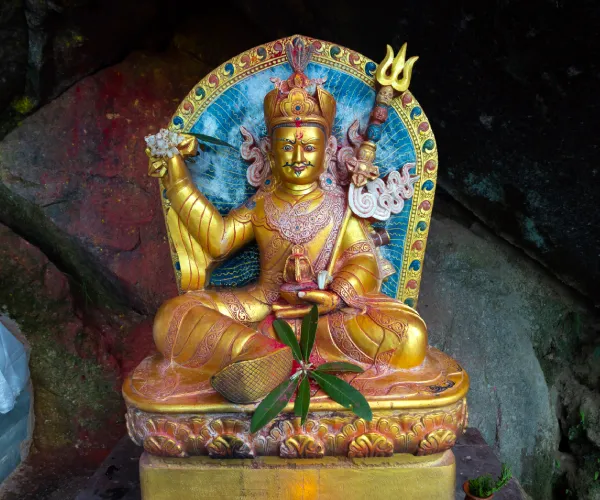
Explore Upper Mustang's sacred monasteries, ancient caves, and timeless Himalayan Buddhist heritage.
The Himalayan Vajrayana Pilgrimage Tour in Upper Mustang is a sacred journey into one of the most preserved tantric Buddhist regions of the Himalayas. Hidden beyond the dramatic passes of northern Nepal, Upper Mustang—once the Kingdom of Lo—remains a living sanctuary of Vajrayana Buddhism, deeply connected to the enlightened activity of Guru Padmasambhava. Revered as Guru Rinpoche, he established Vajrayana teachings across the Himalayan region, consecrating sacred caves, subduing obstructive forces, and transforming the land into a spiritual mandala for future practitioners.
This Upper Mustang pilgrimage tour invites seekers to walk through a landscape blessed by centuries of mantra recitation, deity yoga, and retreat practice. Ancient monasteries, meditation caves, and the walled city of Lo Manthang preserve the living transmission of Himalayan Vajrayana Buddhism. The region’s sacred sites—including cliffside hermitages, sky caves, and historic gompas—continue to embody the blessings of Guru Padmasambhava and the unbroken lineage of tantric masters.
More than a cultural exploration, this Himalayan Buddhist pilgrimage in Upper Mustang is a profound spiritual experience. It offers pilgrims and practitioners an opportunity to connect with pure Vajrayana teachings in their original Himalayan setting—where geography, devotion, and lineage merge into a living path of awakening.
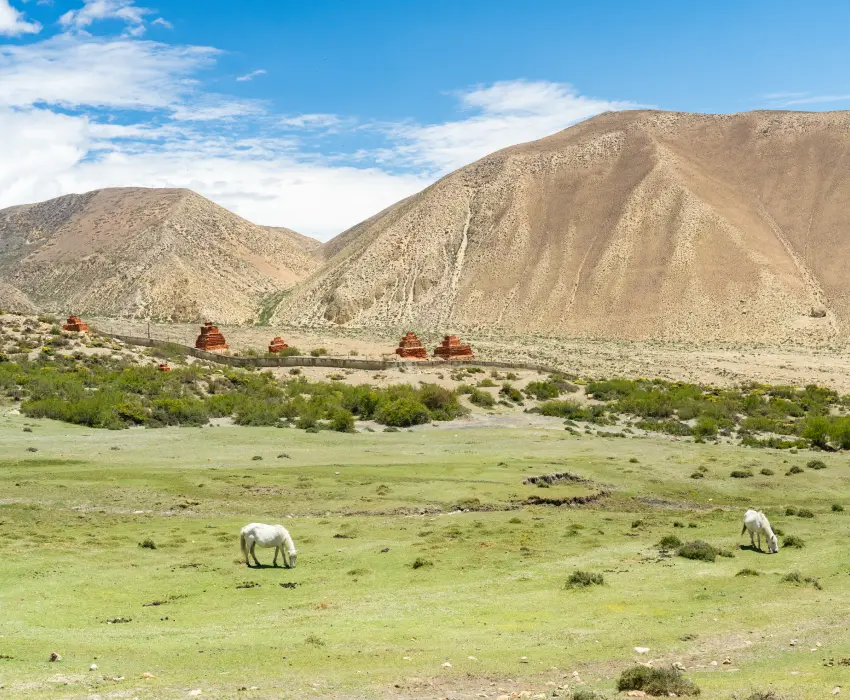
The sacred geography of Upper Mustang forms the spiritual foundation of this Himalayan Vajrayana Pilgrimage Tour. Far beyond a remote Himalayan desert, Upper Mustang is understood in Vajrayana Buddhism as a consecrated mandala—blessed and transformed through the enlightened activity of Guru Padmasambhava. According to local tradition, Guru Rinpoche meditated in caves, subdued negative forces, and sanctified the valleys, making this region a powerful ground for tantric realization.
Towering red cliffs, hidden meditation caves, and ancient monastic settlements are not random features of the landscape—they are part of a sacred design shaped by centuries of retreat practice, ritual ceremonies, and lineage transmissions. The high-altitude silence supports deep contemplation, while the rugged terrain symbolizes the inner path of transformation central to Vajrayana teachings.
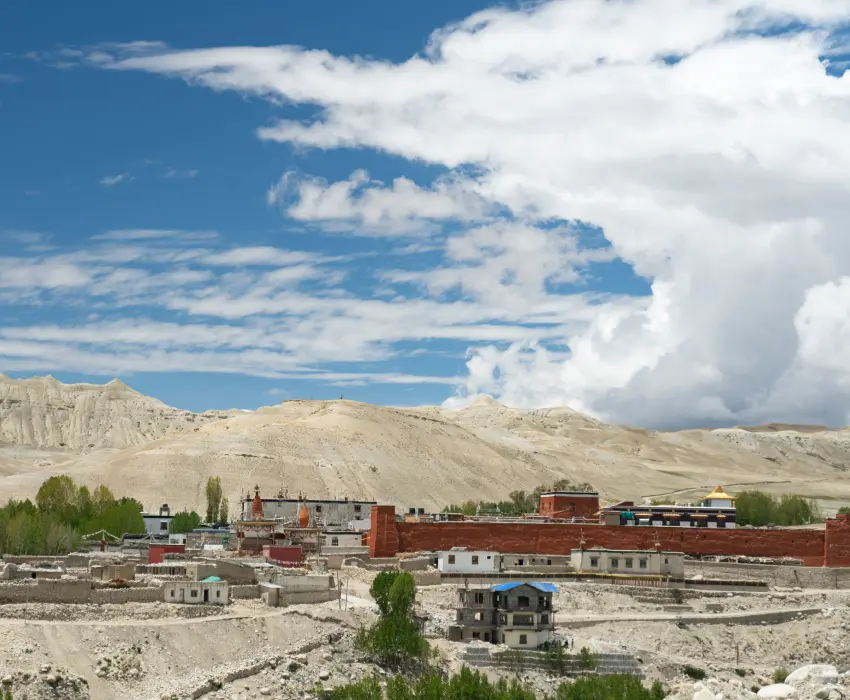
At the heart of this sacred landscape lies Lo Manthang, the historic walled capital that served as both royal and spiritual center of the Kingdom of Lo. From here, the preservation of Himalayan Vajrayana Buddhism radiated across surrounding valleys, caves, and monasteries.
Understanding the sacred geography of Upper Mustang allows pilgrims to approach each monastery, gompa, and retreat cave not simply as a historic monument, but as a living energy field. Every step across this terrain becomes part of the pilgrimage itself—an offering of devotion within a mandala shaped by Guru Padmasambhava’s blessings and sustained by centuries of Vajrayana practice.
Upper Mustang preserved pure Vajrayana Buddhism largely because of its geographical isolation, strong royal patronage, and uninterrupted monastic lineage. For centuries, this hidden Himalayan kingdom remained naturally protected by high mountain passes and restricted access, allowing tantric teachings to flourish without major external influence. While many regions experienced political and cultural shifts, Upper Mustang safeguarded its ritual traditions, meditation practices, and lineage transmissions in their authentic form.
The early consecration of the land by Guru Padmasambhava established Upper Mustang as a spiritual stronghold of Himalayan Vajrayana. His blessings, combined with the dedication of successive lineage masters, created a continuous stream of tantric practice rooted in deity yoga, mantra recitation, protector rituals, and long-term retreat culture. Monasteries in and around Lo Manthang became centers of scriptural study, ritual mastery, and esoteric initiation, ensuring that the profound methods of Vajrayana were transmitted intact from teacher to disciple.
Royal families of the Kingdom of Lo also played a crucial role by supporting monasteries, commissioning sacred art, and protecting monastic communities. This deep integration of spiritual life with governance allowed Vajrayana Buddhism to remain not only a religious system but the very heart of Mustang’s cultural identity.
As a result, Upper Mustang today stands as one of the rare Himalayan regions where pure Vajrayana Buddhism continues to be practiced in its traditional form—making this Himalayan Vajrayana pilgrimage tour a journey into an authentic and living tantric heritage.
The Himalayan Vajrayana Pilgrimage Tour in Upper Mustang unfolds through a series of powerful sacred sites, each carrying centuries of tantric blessing, meditation energy, and lineage transmission. From ancient monasteries established in the early spread of Vajrayana Buddhism to hidden meditation caves sanctified by Guru Padmasambhava, this pilgrimage gradually reveals the spiritual mandala of Upper Mustang.
Below are the principal sacred sites included in this Upper Mustang Vajrayana pilgrimage—each to be explored deeply in the following sections.
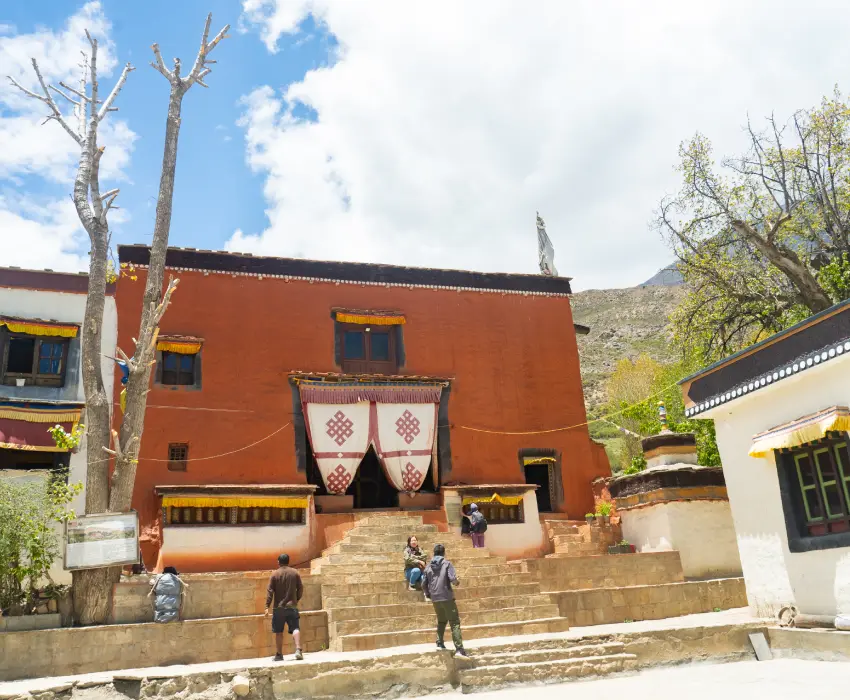
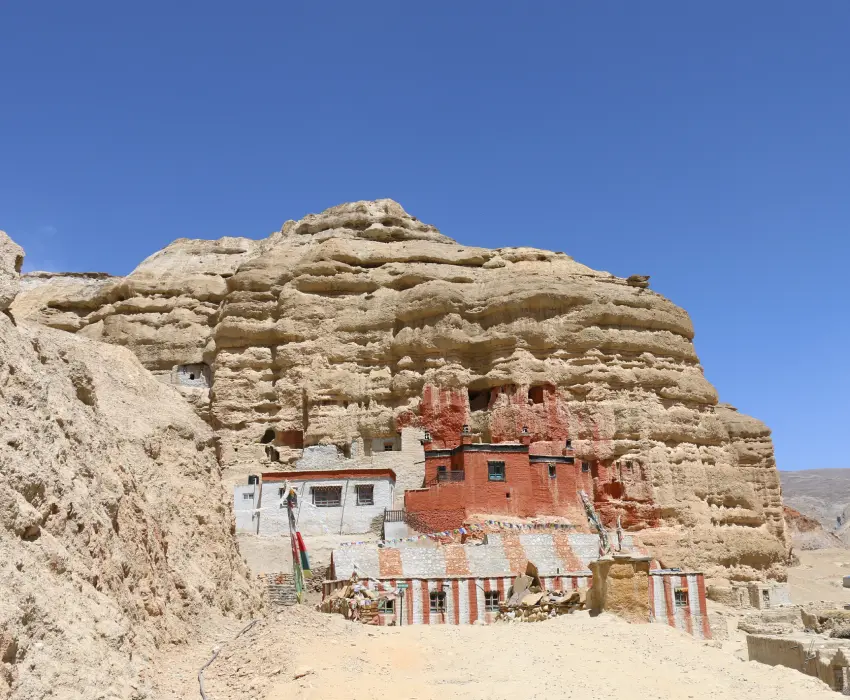
Standing quietly in the windswept desert of Upper Mustang, Lo Gekar Monastery—also known as Ghar Gompa—is revered as the oldest Vajrayana monastery in Upper Mustang and is traditionally believed to predate even Samye Monastery in Tibet. Its sacred origin is inseparably connected to Guru Padmasambhava, the Lotus-Born master who established Vajrayana Buddhism across the Himalayan region in the 8th century.
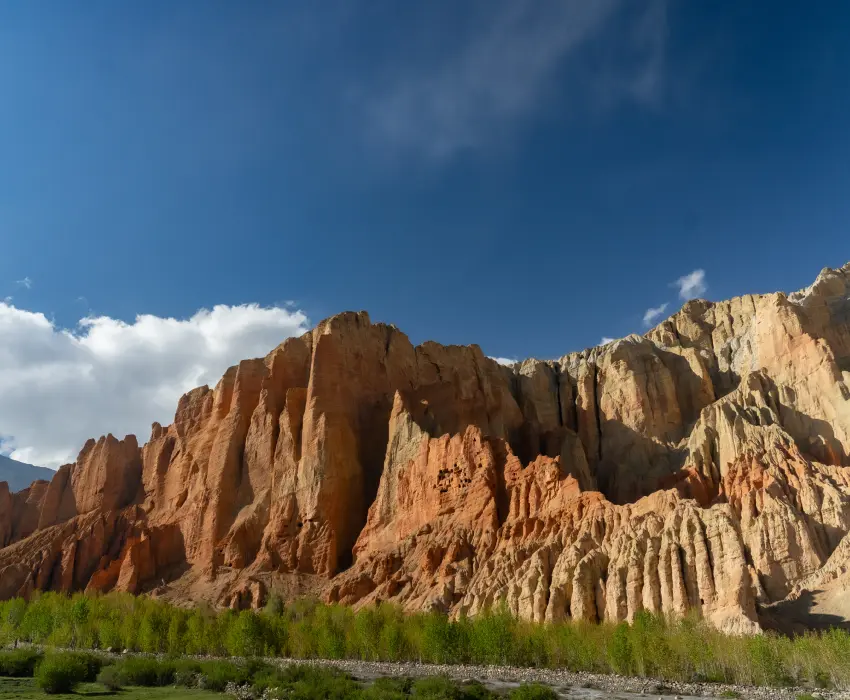
According to ancient Himalayan tradition, when the construction of Samye Monastery in Tibet was repeatedly obstructed by a powerful female spirit who destroyed its foundations each night, Guru Rinpoche traced the source of this negative force to the kingdom of Lo. Through profound tantric realization, he discovered that the heart of the obstructing energy lay beneath the ground where Lo Gekar now stands. Here, he subdued and transformed the force—not through destruction, but through spiritual mastery. The towering red cliffs of Dhakmar nearby are said to be stained by the symbolic blood of that subdued demon, marking the triumph of wisdom over ignorance. By establishing Lo Gekar first, Guru Padmasambhava “pinned” the destabilizing energies to the earth, creating a spiritual anchor that allowed the Dharma to flourish throughout Tibet and the Himalayan plateau.
Architecturally and spiritually, Lo Gekar Monastery embodies the essence of the Vajrayana “Diamond Vehicle” path—the transformation of negative energies into enlightened wisdom. As a stronghold of the Nyingma tradition, its thick mud-brick walls have withstood more than 1,200 years of Himalayan winds. Inside, the monastery preserves a rare collection of ancient mani stones intricately carved and painted with Buddhas, protectors, and tantric deities. These are not merely decorative carvings but sacred expressions of early Himalayan Buddhist iconography, maintained in a style largely unchanged for centuries.
For pilgrims on this Himalayan Vajrayana pilgrimage tour, Lo Gekar is not simply a historical monument; it is a powerful spiritual energy field. The juniper-scented halls, dimly lit prayer chambers, and sacred ground blessed by Guru Padmasambhava invite deep contemplation. To stand within Ghar Gompa is to enter the living presence of the Great Adepts and to connect directly with the tantric force that shaped the spiritual destiny of Upper Mustang.
Within the ancient walled capital of Lo Manthang rises the magnificent Thubchen Lhakang Monastery, one of the most important and historic Sakya monasteries in Upper Mustang. Constructed in the late 15th century during the golden era of the Kingdom of Lo, this grand monastery stands as a powerful symbol of the flourishing of Vajrayana Buddhism in the trans-Himalayan desert. For centuries, it has served as a spiritual, cultural, and scholastic heart of Lo Manthang.
As a principal monastery of the Sakya lineage, Thubchen Lhakang reflects the depth and refinement of the Sakya tradition, particularly its Lamdre (“Path and Its Fruit”) teachings—one of the most profound systems of tantric philosophy and practice within Tibetan Buddhism. Through these transmissions, the monastery became not only a sacred space of devotion but also a vital center for lineage preservation, ritual discipline, and esoteric instruction in Upper Mustang.
From the outside, its thick mud-brick walls appear fortress-like, standing resilient against the Himalayan winds. Yet upon entering the vast assembly hall, one encounters a breathtaking interior supported by massive wooden pillars and illuminated by centuries-old murals that cover the walls in vibrant sacred imagery. These mural cycles depict mandalas, celestial Buddhas, lineage masters, bodhisattvas, and powerful Dharma protectors. Influenced by the master artisans of the Kathmandu Valley, the paintings reflect a rare fusion of Newar craftsmanship and Tibetan iconography, making Thubchen Lhakang one of the finest surviving examples of Himalayan Buddhist art.
At the center of the main hall sits a majestic statue of Shakyamuni Buddha, surrounded by enlightened figures that anchor the space in serene presence. When butter lamps flicker against the ancient paintings and the low chanting of monks fills the chamber, the monastery feels timeless—its spiritual energy sustained through more than five centuries of uninterrupted practice.
Unlike many historic monuments that have fallen silent, Thubchen Lhakang remains an active Sakya monastery where daily pujas, seasonal rituals, and community ceremonies continue to shape the rhythm of life in Lo Manthang. During sacred festivals, the monastery becomes the spiritual epicenter of the walled city, hosting tantric ceremonies and masked cham dances invoking protective deities and blessings for the kingdom.
For pilgrims journeying through Upper Mustang, Thubchen Lhakang represents the institutional strength and continuity of Vajrayana Buddhism. Where ancient caves and hermitages reveal the raw meditative power of the early tantric masters, this historic Sakya monastery embodies the organized transmission of Dharma—preserved through scholarship, ritual, and disciplined monastic life. To stand within its vast prayer hall is to witness Vajrayana not only as legend and sacred narrative, but as a living tradition that continues to breathe within the heart of Upper Mustang.
Within the sacred walls of Lo Manthang stands the magnificent Jampa Lhakang, the Sacred Maitreya Temple of Upper Mustang and one of the most spiritually significant monuments of the Kingdom of Lo. Built in the early 15th century (around 1410 AD) by Angun Sangpo, son of the revered King Ame Pal, this monumental temple was conceived as a living Maitreya Mandala—a sacred architectural prayer dedicated to ushering in peace, harmony, and the flourishing of the Dharma.
Its exterior, adorned with traditional Sakya stripes of red, white, and grey, conceals an awe-inspiring vision within: a colossal, two-story gilded copper statue of Maitreya, the Buddha of the Future. Seated gracefully on a lion throne in a posture symbolizing readiness, Maitreya is depicted prepared to descend from Tushita Heaven to renew the teachings in a future age. In Vajrayana understanding, such a monumental form is not merely devotional art—it is a three-dimensional mandala, a tangible field of merit. To stand before it is to establish a karmic link with the future awakening of humanity.
The interior of Jampa Lhakang unfolds as a vertical journey through layers of realization. The ground floor forms a sacred circumambulatory path, where pilgrims walk around the feet of the Great Maitreya while surrounded by walls painted with intricate mandalas. These murals—masterpieces created by skilled Newar artisans—depict profound tantric cosmology, including the 108 forms of Vajrasattva and the universal Buddha Vairocana. Each mandala acts as a geometric map of enlightenment, guiding practitioners in the transformation of the five poisons—ignorance, attachment, aversion, pride, and jealousy—into the five transcendental wisdoms.
Ascending to the upper level, visitors come face-to-face with the serene golden gaze of Maitreya. Traditionally illuminated by flickering butter lamps, the atmosphere shimmers with sacred stillness. In that gentle glow, the future Buddha’s presence feels immediate and intimate, bridging time between the present age and the promise of awakening to come.
As a major center of Sakya Vajrayana practice, Jampa Lhakang was historically a place of high tantric empowerments and the transmission of Pratimoksha vows. Rooted in the Lamdre (“Path and Its Fruit”) tradition, the temple functioned as a spiritual stronghold for the Sakya masters of Mustang. Its massive mud-brick walls—nearly two meters thick—reflect the Vajrayana symbolism of the “Vajra-fence,” a protective boundary safeguarding sacred teachings from degeneration.
Today, Jampa Lhakang remains a luminous reminder of Mustang’s 15th-century Golden Age. The golden face of the Future Buddha continues to watch over the high desert kingdom, offering blessings and quiet assurance that the Dharma endures. For pilgrims traveling through Upper Mustang, this Sacred Maitreya Temple is not only a historic monument—it is a living embodiment of hope, continuity, and the timeless promise of enlightenment.
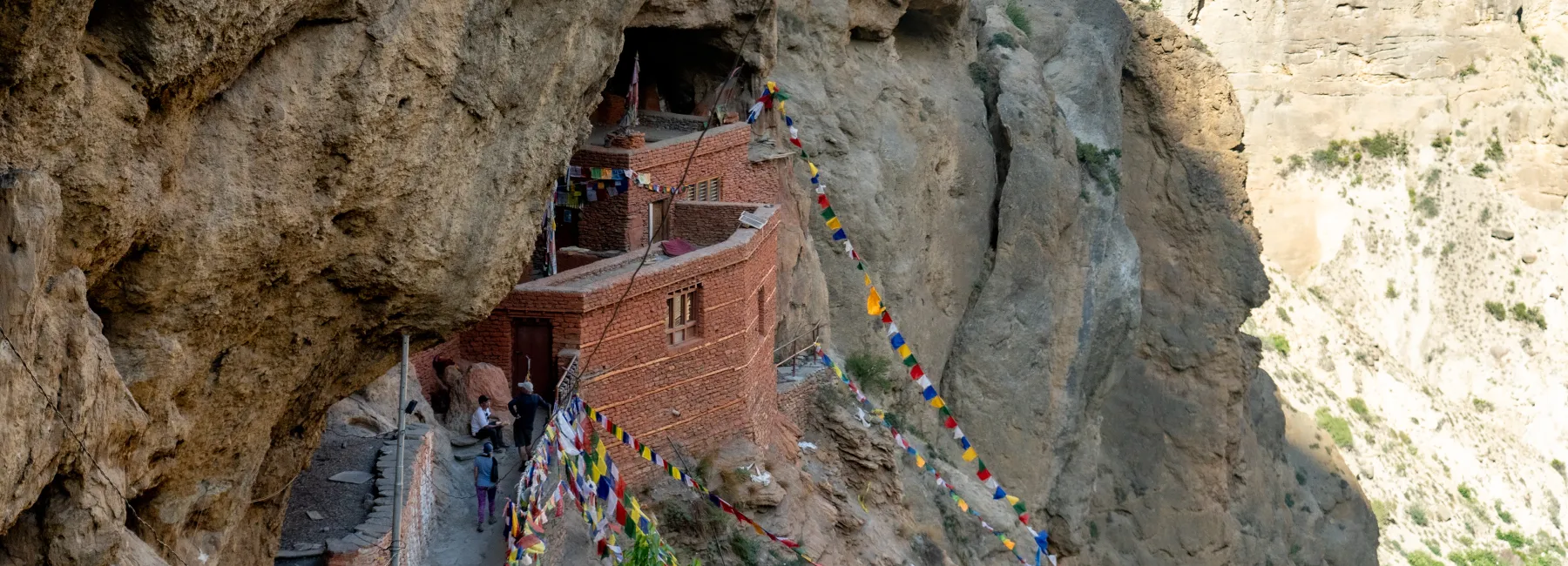
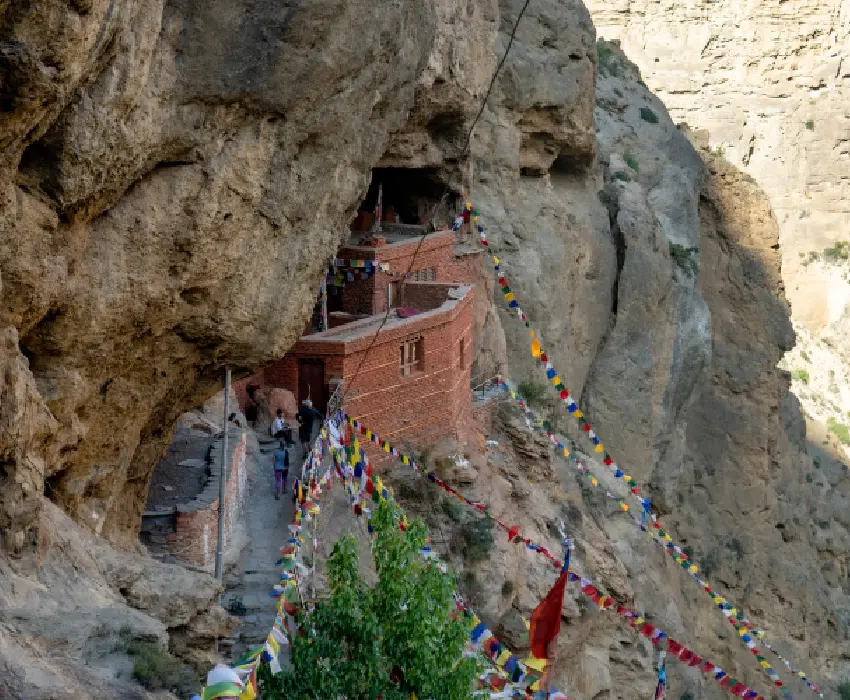
Hidden within the jagged, organ-pipe cliffs of the Yara-Gara region, Luri Gompa is one of the most enigmatic and visually striking sites in Upper Mustang. Unlike the grand urban temples of Lo Manthang, Luri Gompa is a cave monastery of the Drukpa Kagyu lineage, carved directly into the towering sandstone cliffs. Established around the 14th century, it embodies the essence of Vajrayana meditation, where the isolation of the high-altitude desert creates a natural sanctuary for hermitage practice. The monastery is divided into a lower prayer hall used for communal rituals and an upper cave temple, accessible only by a steep climb. This sacred hollow serves as a spiritual womb where the boundaries between the natural world and the tantric cosmos dissolve.
At the heart of Luri Gompa lies the inner sanctum, a small circular cave chamber housing a perfectly preserved Chorten carved from living rock and painted with exquisite detail. Surrounding the stupa are some of the most refined Vajrayana murals in the Himalayas, executed in an Indo-Newar style. The ceiling displays a mandala of the Eight Mahasiddhas—the Great Adepts of India—illustrating the Drukpa Kagyu emphasis on direct, experiential realization over scholarly learning. The walls feature the Five Dhyani Buddhas and protective deities, their colors vibrant thanks to the dry, sun-protected environment of the cliff.
Luri Gompa is a site of hidden transmission and profound meditative practice. As a Drukpa Kagyu hermitage, it was a refuge for practitioners of the Six Dharmas of Naropa, seeking the Great Seal (Mahamudra) through solitary retreat. The cliffside monastery also reflects the Vajrayana concept of the Abode of Dakinis, sacred spaces where female wisdom spirits are said to congregate. The rock itself is believed to retain the spiritual energy of centuries of meditators, making every step within the cave a journey into consecrated space. Today, Luri Gompa continues to draw pilgrims and Vajrayana practitioners, offering an encounter with the raw, mystical heart of Mustang and the timeless pursuit of enlightenment at the highest reaches of the earth.
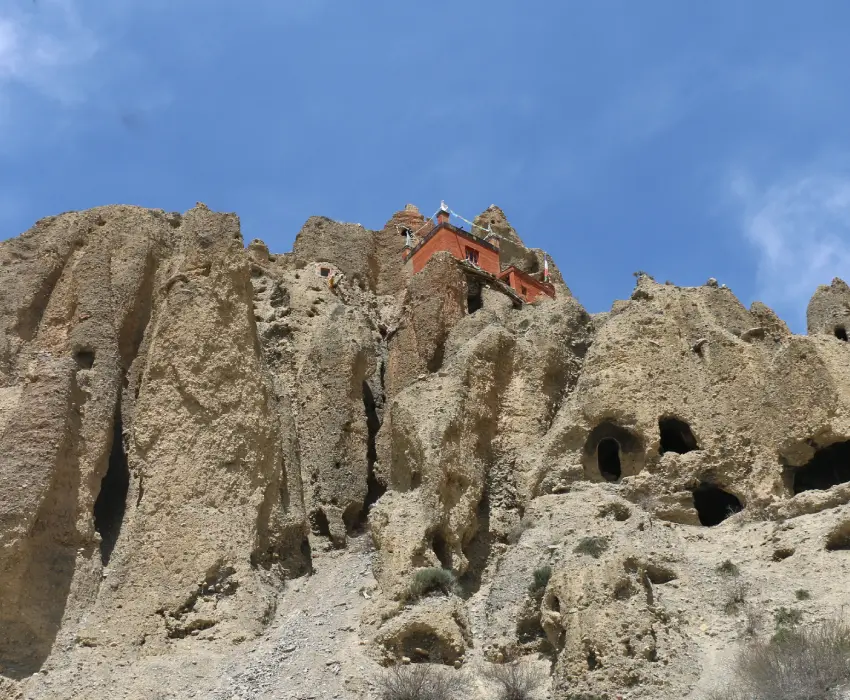
Perched along the sheer cliffs of Upper Mustang near the Tibetan border, Choser Cave Complex—commonly called the Sky Caves of Mustang—is a breathtaking blend of history, archaeology, and Vajrayana spirituality. Originally carved thousands of years ago for habitation and defense, these multi-storied cave dwellings evolved into profound meditation sanctuaries as Lo became a center for tantric practice. The most renowned, Shija Jhong, spans five stories with over 40 rooms connected by vertical tunnels and primitive ladders, reflecting a rare period in Himalayan history where the need for security merged with the pursuit of spiritual isolation.
Within Vajrayana tradition, particularly in Nyingma and Kagyu lineages, the Choser caves served as ultimate retreat centers. Each chamber became a natural temple, where the earth’s concentrated energy supported intense practice. Many caves were consecrated with faded but intricate 13th- and 14th-century murals depicting mandalas, Buddhas, and protective deities. These spaces allowed yogis and hermits to undertake long-term retreats, focusing on the Six Dharmas of Naropa or Dzogchen (Great Perfection), with the cliffs themselves regarded as the “Womb of the Dakinis,” where meditators could confront the nature of mind in complete solitude and silence.
The Choser Cave Complex is more than a series of caves; it was a vertical village where monastic and lay life coexisted. Some caves functioned as assembly halls or Gompas, others as living quarters or granaries. Rock-cut Chortens and altars carved into the cliffs mark the transformation from functional dwellings into consecrated Vajrayana spaces. Visiting the Sky Caves today offers a journey through the layered history of Mustang—from its ancient Bon roots to the sophisticated tantric practice established under the guidance of masters like Guru Padmasambhava—standing as a timeless testament to human resilience and spiritual aspiration high in the Himalayas.
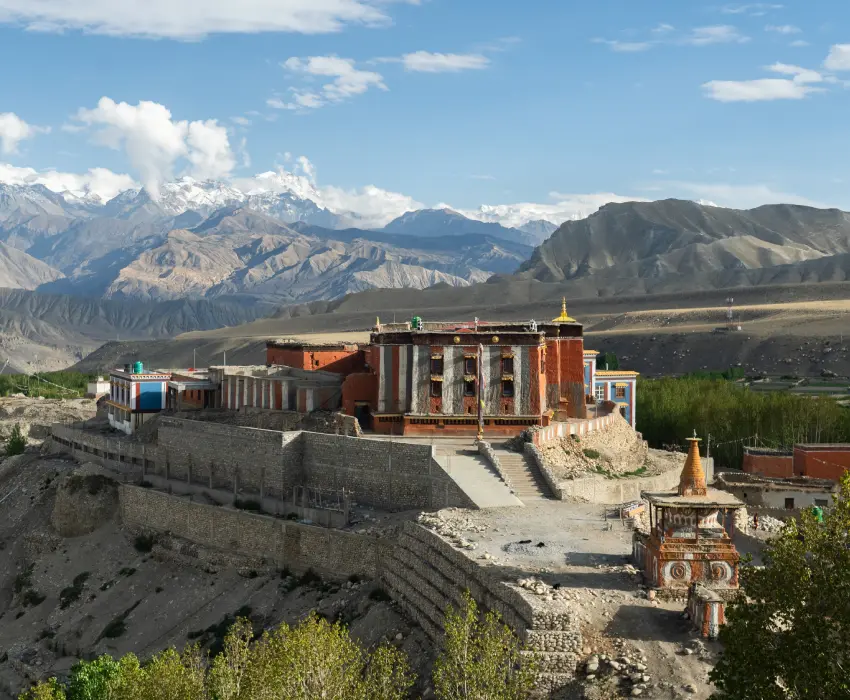
Dominating the skyline of Tsarang, the second-largest settlement in Upper Mustang, Tsarang Monastery stands as a monumental fortress of the Sakya Vajrayana tradition. Built in the 14th century, this massive red-ochre monastery served as a primary center of Buddhist learning and spiritual power, rivalling Lo Manthang in both influence and sacred importance. Physically and symbolically connected to the neighboring Tsarang Palace, the monastery reflects the Himalayan ideal of Chos-srid-gnyis-ldan—the union of religion and politics—demonstrating how governance and spiritual authority were intertwined in the Kingdom of Lo. As a major monastic seat, Tsarang functioned not only as a place of prayer but as a vast Shedra (monastic college) where monks mastered the Sakya lineage’s philosophical and tantric systems, particularly the Lamdre (Path and Fruit) teachings.
Inside, the monastery immerses visitors in the Vajrayana Golden Age of Upper Mustang. The Great Assembly Hall houses ancient gold-lettered manuscripts, some of the Himalayas’ most precious texts, containing secret tantras and commentaries of Sakya masters. The walls are adorned with exquisite murals, depicting Buddhas, Bodhisattvas, and Sakya lineage holders, rendered in deep mineral pigments that have endured for centuries. Sacred treasures include massive statues of Maitreya and Shakyamuni, and a Protector Chapel (Gonkhang) where fierce deities like Mahakala reside, embodying the Vajrayana principle of enlightened activity—subduing ego and negative forces through tantric power.
As a living site of Vajrayana practice, Tsarang Monastery remains central to the spiritual life of Upper Mustang. Its immense, windowless lower walls and commanding position above a deep gorge reflect the indestructible “Vajra” nature of the teachings it preserves. Annual festivals and Cham masked dances continue to animate the monastery, while the chanting of monks and the resonance of long copper horns (Dungchen) broadcast protective energy across the wind-swept plateau. Even today, Tsarang stands as a vital guardian of the Sakya tradition, a fortress of both learning and meditation in the heart of Mustang’s sacred landscape.
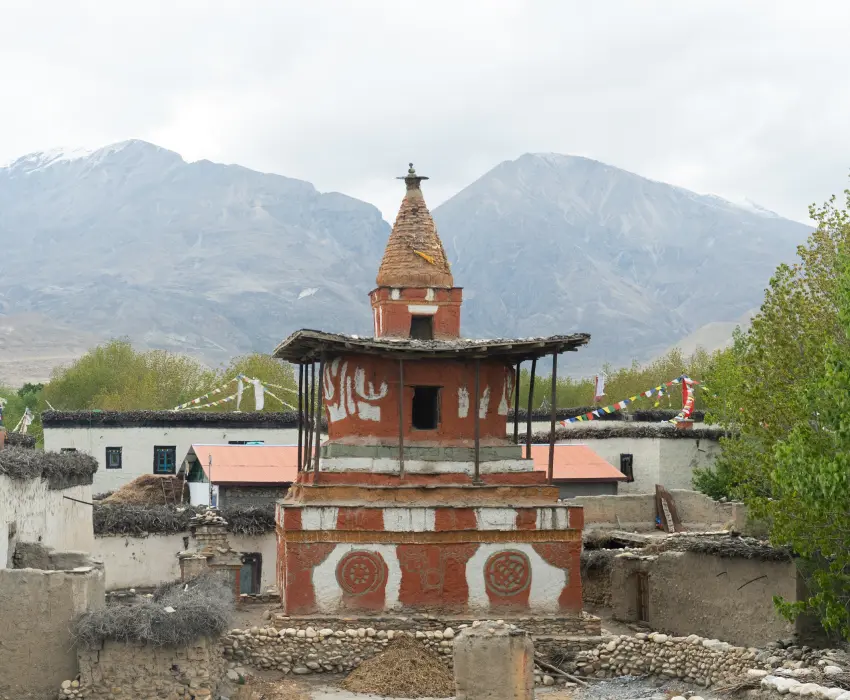
Beyond the major monasteries and cliffside retreats highlighted above, Upper Mustang is dotted with countless other sacred sites intimately connected to Vajrayana Buddhism and the enlightened activity of Guru Padmasambhava. Hidden caves, small chapels, ancient stupas, and meditation spots bear silent witness to the Guru’s tantric journeys and the living legacy of the Nyingma, Sakya, and Drukpa Kagyu lineages. Many of these sites, though lesser-known, carry profound spiritual energy—places where the veil between the mundane and the divine is thin, and the blessings of Guru Padmasambhava continue to resonate. During the pilgrimage, travelers will have the rare opportunity to visit these en route sacred sites, experiencing the subtle power and continuity of Vajrayana practice in the high Himalayas, beyond the famed landmarks, and connecting deeply with the living tradition that has flourished for over a millennium.
Embark on a transformative journey through the sacred landscapes of Upper Mustang, where the living legacy of Guru Padmasambhava and the pure traditions of Vajrayana Buddhism come alive. This pilgrimage offers a rare opportunity to visit ancient monasteries, cliffside meditation caves, and hidden sacred sites, each imbued with centuries of tantric practice and spiritual energy. Walk in the footsteps of the Great Adepts, witness self-arising images and consecrated statues, and feel the profound presence of Vajrayana deities that continue to protect and guide practitioners. Whether you seek inner purification, meditation retreats, or a deeper understanding of Himalayan Vajrayana, this journey through Upper Mustang’s mystical terrain promises to awaken your heart, mind, and spirit. Step into this sacred man
Upon arrival at Tribhuvan International Airport in Kathmandu, our representative will warmly welcome you and assist with your transfer to the hotel. After check-in, you will have time to rest and recover from your journey. The remainder of the day is free for relaxation or gentle exploration around the hotel area. Kathmandu, a historic crossroads of Himalayan culture and spirituality, offers a meaningful starting point for your pilgrimage following the sacred footsteps of Guru Padmasambhava, also known as Guru Rinpoche.
After breakfast, you travel about 1 hour (approximately 20 km) south of Kathmandu to Pharping, one of the most revered Vajrayana Buddhist pilgrimage destinations in Nepal. Often called the “second Bodh Gaya,” this sacred valley is where Guru Padmasambhava attained profound spiritual realization.
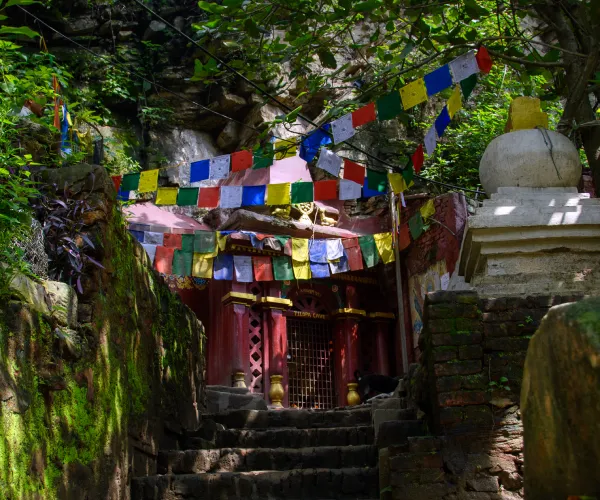
The day begins with a visit to Yanglesho Cave, a revered meditation site associated with Guru Rinpoche and Princess Mandarava. Nearby, you explore Asura Cave, where Guru Padmasambhava meditated and attained the realization of Mahamudra Vidyadhara. Pilgrims can also observe the sacred self-arisen handprint believed to have manifested during his meditation practice.
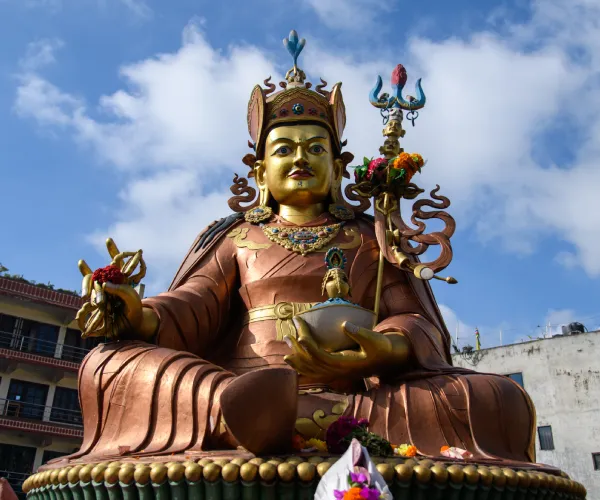
You will then visit the Pharping Vajrayogini Temple, an important tantric shrine dedicated to Vajrayogini, followed by a visit to the impressive Guru Padmasambhava Statue, which offers panoramic views of the surrounding valley.
During this day, our team will also submit and process the Restricted Area Permit application required for travel to Upper Mustang. After spending time exploring these sacred sites, you return to Kathmandu in the late afternoon for rest and preparation for the upcoming Himalayan journey.
After breakfast, you begin the scenic journey from Kathmandu to Pokhara, traveling approximately 6–7 hours (around 200 km) through the beautiful landscapes of central Nepal. The route follows the Trishuli and Marsyangdi river valleys, passing terraced hillsides, rural villages, and lush countryside.
Several short breaks along the way allow time to enjoy the changing scenery and local surroundings. By afternoon you arrive in Pokhara, a peaceful lakeside city situated beneath the Annapurna mountain range. After checking into your hotel, the evening is free to walk along the shores of Phewa Lake, where the calm atmosphere and mountain views provide a perfect setting for reflection before continuing toward Mustang.
After breakfast, the journey continues northward toward the high Himalayan landscapes of Mustang. Today’s travel takes approximately 7–8 hours, gradually ascending along the dramatic Kali Gandaki Valley.
As the route climbs higher into the trans-Himalayan terrain, the scenery transforms from green hills into a rugged desert-like landscape shaped by wind and ancient geological formations. Passing through traditional Himalayan villages and historic trade routes, you eventually arrive at Kagbeni, an ancient settlement that serves as the gateway to the Upper Mustang region.
Here you will visit Kag Chode Thupten Samphel Ling Monastery, an important monastery of the Sakya tradition and a spiritual center of the village. The monastery reflects the deep connection between Tibetan Buddhist culture and the unique traditions of Mustang. After exploring the monastery and the historic village alleys, the evening is spent in Kagbeni preparing for the journey further into the hidden Himalayan kingdom.
After breakfast, you continue deeper into Upper Mustang with approximately 5–6 hours of travel through the dramatic landscapes of the trans-Himalayan region. The journey passes through traditional Mustang villages, expansive valleys, and striking cliff formations.
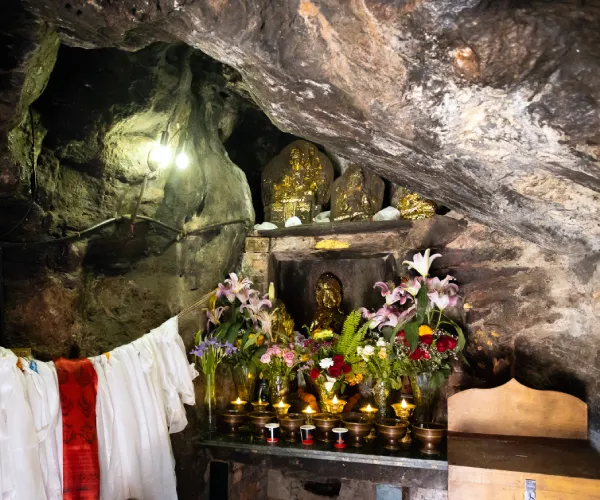
The highlight of the day is a pilgrimage to Chungsi Cave, one of the most sacred meditation sites associated with Guru Padmasambhava. Hidden within a natural rock formation, this cave is believed to be a place where the master meditated while traveling through the Himalayas toward Tibet. Inside the cave, visitors may observe naturally formed sacred images believed to be self-arisen manifestations (Rangjung) of enlightened beings.
After spending time in reflection at this powerful spiritual site, the journey continues toward Ghami, a traditional Mustang village surrounded by dramatic red cliffs. Ghami is also known for one of the longest Mani walls in Nepal, composed of stones carved with sacred Buddhist mantras. The evening is spent exploring the peaceful village and resting after the day’s pilgrimage.
Today’s journey takes approximately 5–6 hours across the vast and dramatic landscapes of Upper Mustang toward its historic capital. Along the way you pass the striking red cliffs of Dhakmar, one of the most iconic geological formations in the region.
A significant stop today is Ghar Gompa (also known as Lo Gekar Monastery), regarded as one of the oldest monasteries in Upper Mustang and traditionally believed to have been established by Guru Padmasambhava in the 8th century. The monastery is considered a powerful place for prayers and blessings, and pilgrims often offer butter lamps here before continuing the journey.
After visiting the monastery, the journey continues across high Himalayan plateaus until you reach Lo Manthang, the ancient walled capital of the former Kingdom of Mustang. This historic city preserves centuries-old Tibetan Buddhist culture, architecture, and traditions. After arriving and settling into your accommodation, you have time to explore the surrounding streets of this remarkable Himalayan settlement.
Today is dedicated to exploring the spiritual and cultural treasures of Lo Manthang, the historic capital of Mustang. The day begins with visits to several of the city’s most important monasteries and temples that reflect the deep Vajrayana Buddhist heritage of the region.
You will visit Jampa Lhakhang, also known as the Maitreya Temple, which houses a magnificent statue of the Future Buddha and remarkable ancient murals. Another important site is Thubchen Monastery, famous for its impressive assembly hall and intricate wall paintings depicting the Vajrayana pantheon.
In the afternoon, a short excursion takes you to the Choser Cave Complex (Jhong Caves). These extraordinary multi-level caves carved into towering cliffs were historically used by monks and practitioners for meditation retreats and spiritual practice. Exploring the caves offers a fascinating glimpse into the ancient spiritual life of Mustang.
After returning to Lo Manthang, the evening is free for quiet reflection, allowing you to fully absorb the profound atmosphere of this remarkable Himalayan kingdom.
After breakfast in Lo Manthang, the journey continues toward the remote eastern valleys of Mustang. Today’s travel takes approximately 5–6 hours, crossing vast high-altitude plateaus and dramatic canyon landscapes shaped by centuries of wind and erosion.
The main destination of the day is Luri Gompa, one of the most remarkable cave monasteries in the Mustang region. Perched high on a sandstone cliff, this sacred meditation site is believed to date back to the 14th century. Inside the cave temple, visitors can see ancient frescoes depicting Vajrayana Buddhist masters and the Eight Great Siddhas, reflecting the rich tantric traditions of Himalayan Buddhism.
After spending time exploring this spiritually powerful cave monastery, the journey continues to the quiet village of Yara, where you stay overnight surrounded by the stark beauty of Mustang’s remote landscape.
Leaving the remote eastern valley of Yara, today’s journey travels south toward the sacred pilgrimage destination of Muktinath. The travel duration today is approximately 6–7 hours, following the ancient Himalayan trade routes through the dramatic landscapes of Mustang.
Muktinath, known in Tibetan as Chumig Gyatsa, is one of the most sacred pilgrimage sites in the Himalayas, revered by both Buddhists and Hindus. In Vajrayana Buddhism, it is recognized as one of the 24 Tantric Power Places (Pithas) connected with the sacred geography of tantric practice.
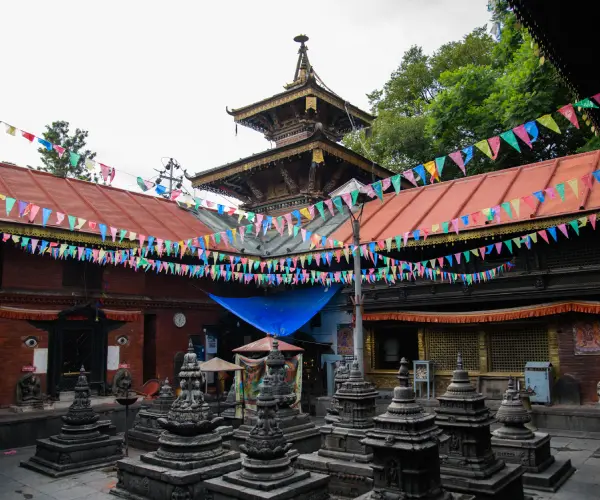
During the visit, you will explore the temple complex, including the famous 108 water spouts, where pilgrims traditionally perform ritual purification. Another remarkable feature of this site is the eternal natural flame, which burns continuously from natural gas emerging from the earth, symbolizing the sacred union of the elements of fire and water. The evening is spent near the temple area, allowing time for reflection in this powerful spiritual setting.
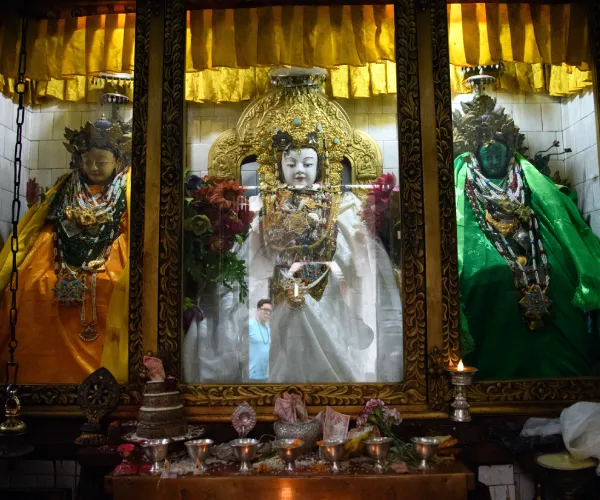
After breakfast, you begin the day by visiting Narsingh Gompa in Muktinath, an important monastery that houses a revered statue of Guru Padmasambhava. According to local tradition, Guru Rinpoche meditated in this region while traveling through the Himalayan valleys on his journey toward Tibet.
After exploring the monastery and surrounding sacred sites, the journey continues south through the Kali Gandaki valley toward Pokhara. The travel time today is approximately 7–8 hours, passing through traditional Himalayan villages and dramatic river valleys.
By evening you arrive in Pokhara, where the lush greenery and peaceful lakeside environment offer a welcome contrast to the high-altitude landscapes of Mustang. After checking into your hotel, the rest of the evening is free to relax and enjoy the tranquil surroundings.
Today is a day for rest, integration, and reflection after the profound journey through Mustang. Pokhara, located beside the serene Phewa Lake, offers a peaceful setting to absorb the experiences of the pilgrimage.
You may take a leisurely walk along the lakeshore, enjoy the calm natural surroundings, or visit the nearby World Peace Pagoda, a hilltop Buddhist monument that provides panoramic views of the lake, the city, and the Annapurna mountain range. This relaxed day allows travelers to reflect on both the outer journey through sacred Himalayan landscapes and the inner journey of spiritual discovery inspired by the teachings of Guru Rinpoche.
After breakfast, you begin the return journey to Kathmandu, traveling approximately 6–7 hours through the scenic hills and river valleys of central Nepal. The route once again follows the winding highways along the Trishuli River, passing rural villages, terraced farmlands, and lush green hills.
Upon arrival in Kathmandu, you will be transferred to your hotel. The remainder of the day is free for rest or to explore the lively streets and traditional markets of the city, especially the vibrant neighborhood of Thamel, known for its handicrafts, restaurants, and cultural atmosphere.
Today you explore two of the most sacred Buddhist monuments in Nepal. The day begins with a visit to Swayambhunath Stupa, one of the oldest and most revered Buddhist stupas in the Kathmandu Valley. According to tradition, this hilltop sanctuary marks the place where the self-arisen lotus of enlightenment first appeared when the valley was still a primordial lake.
Later, you visit the magnificent Boudhanath Stupa, one of the largest stupas in the world and a major center of Tibetan Buddhism. Here you will join pilgrims and monks in the sacred practice of kora (circumambulation) around the stupa, spinning prayer wheels and offering prayers in gratitude for the safe completion of your spiritual journey through the sacred landscapes associated with Guru Padmasambhava.
The evening is free for final reflections and preparations for departure.
After breakfast, you will be transferred to Tribhuvan International Airport according to your flight schedule. As your journey comes to an end, you depart Nepal carrying the blessings and inspiration of the sacred Himalayan pilgrimage in the footsteps of Guru Padmasambhava, along with memories of the monasteries, caves, and spiritual landscapes that have shaped Vajrayana Buddhism for centuries.
Nirvana Journey is the dedicated spiritual travel division of Asia Buddhist Tours & Treks, specializing in authentic Buddhist pilgrimages, sacred journeys, and transformative experiences across the Himalayan region asiabuddistours.com
© Copyright 2026, The copyright to all content on this website, including photographs, belongs to Nirvana Journey Pvt. Ltd. and cannot be reproduced without our permission. © Nirvana Journey Pvt. Ltd 2026