Explore the sacred Mahavihars where centuries of wisdom and devotion still thrive.
The Kathmandu Valley is often described as an open-air museum of temples and palaces, yet its deepest spiritual treasures remain hidden behind modest brick walls and carved wooden gateways. Within these quiet enclosures lie the Mahavihars, locally known as Baha and Bahi—sacred Buddhist courtyards that have preserved the living heart of Newar Buddhism for more than a thousand years. The Newar Buddhism Mahavihar Tour of Kathmandu Valley is an invitation to enter these sanctified spaces slowly, respectfully, and with openness, discovering a Vajrayana tradition that is still practiced daily by local communities.
Unlike conventional Buddhist heritage tours in Nepal that focus mainly on monumental stupas, this journey leads travelers into intimate courtyards where oil lamps glow at dawn, ritual bells echo softly in the evening, and Bodhisattva images receive daily offerings as they have for generations. These are not ruins or museums; they are living monasteries sustained by hereditary Sangha lineages, community devotion, and ancient ritual cycles. Walking through them is to witness Buddhism not as a philosophy frozen in texts, but as a lived tradition woven into everyday life.
This Baha and Bahi tour in the Kathmandu Valley is designed for all travelers—spiritual seekers, cultural explorers, photographers, scholars, and those entirely new to Buddhism. No prior knowledge is required. Each site is interpreted gently and clearly, allowing visitors to appreciate the spiritual symbolism, architectural meaning, and cultural significance at their own pace. The experience is contemplative rather than overwhelming, offering moments of quiet reflection amid the vibrant life of Nepal’s historic cities.
To understand the depth of this Newar Buddhism Mahavihar Tour, it is essential to first understand the spiritual world from which these sacred spaces emerged. Newar Buddhism is a unique form of Vajrayana Buddhism practiced by the Newar community of the Kathmandu Valley. Rooted in Mahayana philosophy and enriched by tantric practices, it preserves ancient Sanskrit texts, esoteric rituals, Bodhisattva devotion, and a sophisticated system of monastic and priestly lineages.
Unlike monastic traditions elsewhere in the Buddhist world, Newar Buddhism evolved into a householder-based Vajrayana system. Ritual authority is maintained by the Vajracharya and Shakya castes, who serve as hereditary priests, ritual specialists, and guardians of tantric initiations. Their role is not only religious but cultural, preserving festivals, iconography, oral traditions, and ethical values that shape Newar society.
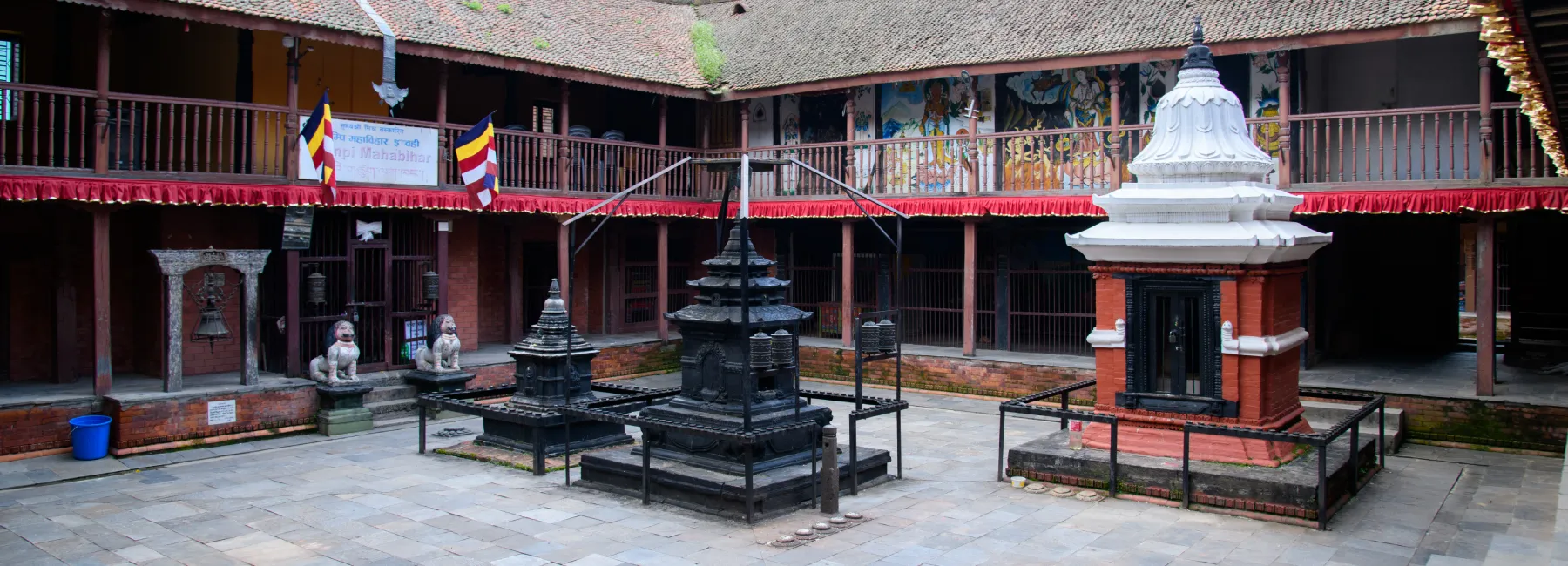
A Baha, also called a Mahavihar, is a fully developed Buddhist monastery organized around a central courtyard. At its heart stands the shrine of a Buddha or Bodhisattva—often Akshobhya, Dipankara Buddha, or Avalokiteshvara (Lokeshvara/Karunamaya). Surrounding the courtyard are shrines, ritual rooms, and residences of Sangha members. These Mahavihars function as places of worship, initiation, teaching, festivals, and community gatherings.
A Bahi represents an older monastic form, historically associated with celibate monks and early scholastic Buddhism. Bahis are often simpler in architectural design and are traditionally located slightly away from dense urban centers. While many Bahis later integrated Vajrayana practices, they still reflect an earlier emphasis on discipline, study, and contemplative life.
Together, Baha and Bahi form the spiritual infrastructure of Vajrayana Buddhism in Nepal, sustaining a living tradition that has survived political change, natural disasters, and modernization without losing its essential character.
Kathmandu, historically known as Kantipur, is not merely the political capital of Nepal but one of the most spiritually layered Buddhist cities in the Himalayas. Long before the rise of modern Nepal, Kathmandu developed as a constellation of Mahavihars (Baha) and Bahis, each functioning as a spiritual nucleus around which neighborhoods, professions, festivals, and social life evolved. For travelers undertaking a Newar Buddhism Mahavihar Tour of Kathmandu Valley, the Mahavihars of Kathmandu offer the clearest introduction to how Vajrayana Buddhism became a lived, community-based tradition rather than a monastic abstraction.
What makes Kathmandu’s Mahavihars especially significant is their continuous ritual life. These are not archaeological remnants; they are sacred courtyards where lamps are still lit every morning, mantras are still recited in Sanskrit and Newari, and Bodhisattvas are still approached as living presences. Entering a Mahavihar in Kathmandu often feels like stepping out of time—busy streets fall silent, and a contemplative calm takes over.
Among all Mahavihars in Kathmandu, Itum Bahal, traditionally known as Keshchandra Mahavihar, holds a place of exceptional importance. Believed to have been established during the Licchavi period and later expanded under Malla patronage, Itum Bahal exemplifies the classical Mahavihar layout based on Vajrayana mandala principles. The spacious courtyard is oriented around the central shrine of Akshobhya Buddha, the immovable Buddha associated with wisdom and the transformation of anger.
Architecturally, Itum Bahal is a harmonious blend of brickwork, carved wooden struts, and metal votive elements that reflect centuries of artistic devotion. Spiritually, it functions as a living ritual center where Vajracharya priests perform daily pujas, seasonal tantric rites, and elaborate Dipankara Buddha ceremonies. During festivals, the courtyard becomes animated with communal offerings, processions, and sacred music, revealing how Mahavihars serve as both spiritual sanctuaries and social anchors.
For visitors on a Mahavihar tour in Kathmandu Valley, Itum Bahal provides a profound introduction to Newar Vajrayana Buddhism as a living mandala—one that integrates cosmology, ritual, art, and community into a single sacred space.
Tham Bahal, also known as Thambahi, is regarded as one of the oldest Bahis in Kathmandu and offers invaluable insight into the valley’s early Buddhist monastic history. Unlike later Mahavihars that developed elaborate Vajrayana iconography, Tham Bahal reflects a more restrained architectural and spiritual aesthetic, emphasizing discipline, study, and contemplative practice.
Historically, Bahis like Tham Bahal were associated with celibate monks and scholastic traditions, serving as centers for scriptural learning and meditation. Although Vajrayana rituals were later incorporated, the Bahi retains its quiet, austere atmosphere. Its courtyard feels introspective, encouraging silence and reflection rather than ceremonial spectacle.
Within the context of a Newar Buddhism Mahavihar Tour, Tham Bahal allows travelers to trace the evolution of Buddhism in Nepal—from early monastic foundations to the richly symbolic Vajrayana practices that followed. It stands as a reminder that Newar Buddhism is layered, preserving multiple historical phases within a single tradition.
Sikhamu Bahal holds a special place within Kathmandu’s Buddhist landscape due to its close association with the cult of Avalokiteshvara, the Bodhisattva of Compassion, locally revered as Lokeshvara. Compassion is not merely a philosophical ideal in Newar Buddhism; it is embodied through ritual, storytelling, and community service, all of which find expression within this Mahavihar.
The courtyard of Sikhamu Bahal serves as a devotional space where Bodhisattva worship is interwoven with local legends and oral traditions. Ritual offerings, especially during Avalokiteshvara-related festivals, transform the Mahavihar into a focal point of collective prayer and merit-making. The presence of Vajracharya priests, lay devotees, and neighborhood families highlights the communal nature of Buddhist practice here.
For travelers, Sikhamu Bahal reveals how Newar Buddhism integrates spiritual ideals into everyday life. It demonstrates that Mahavihars are not isolated religious institutions but living centers of compassion, ethical conduct, and social harmony.
Bhaskardev Sanskarita Mahavihar, also known historically as Kva Bahal, is closely associated with royal patronage during the Licchavi period, particularly King Bhaskardeva. This Mahavihar illustrates how political authority and Buddhist institutions were deeply intertwined in early Nepalese history.
The Mahavihar’s architectural elements, inscriptions, and ritual legacy reflect centuries of support from rulers and aristocratic families. Spiritually, it continues to function as a Vajrayana ritual center where traditional pujas and lineage-based ceremonies are preserved. Its survival through political changes underscores the resilience of Newar Buddhism and its ability to adapt while maintaining core spiritual principles.
Beyond the most famous sites, Kathmandu is home to numerous community-centered Mahavihars such as Te Bahal, Konti Bahal, and Guita Bahal. While less monumental in scale, these Mahavihars are equally important for understanding Newar Buddhism as a lived tradition.
These courtyards serve local Sangha members and neighborhood families, hosting daily rituals, life-cycle ceremonies, and seasonal festivals. Their architecture is modest yet deeply symbolic, often centered on Dipankara Buddha images that emphasize continuity, lineage, and merit accumulation. Visiting these Mahavihars allows travelers to experience Buddhism as it is practiced quietly and consistently, away from crowds.
Kwa Bahal, popularly known as Kathesimbhu, is architecturally modeled after Swayambhunath Stupa, reflecting the deep symbolic connections between Mahavihars and stupas in Newar Buddhism. The central chaitya within the courtyard mirrors Swayambhu’s form, making it a powerful urban microcosm of the valley’s most sacred Buddhist site.
Ritually active and easily accessible, Kwa Bahal attracts both local devotees and visitors seeking a contemplative pause within the city. It illustrates how Mahavihars function as spiritual extensions of larger pilgrimage centers, bringing sacred cosmology into everyday urban life.

Patan, traditionally known as Lalitpur or Yala in the Newari language, is widely regarded as the spiritual and artistic heart of Newar Buddhism. While Kathmandu represents the administrative and political center, Patan embodies the ritual, philosophical, and artistic refinement of Vajrayana Buddhism as it evolved in the Kathmandu Valley. For travelers on a Newar Buddhism Mahavihar Tour, Patan offers the most immersive encounter with living Mahavihars, where daily ritual life continues with remarkable consistency.
Unlike other historic cities, Patan is structured almost entirely around Buddhist institutions. Mahavihars here are not isolated monuments; they form an interconnected sacred network, each supporting the others through shared festivals, lineage obligations, and ritual calendars. Walking through Patan feels like moving through a continuous mandala, where every alleyway may lead to a hidden Baha, and every courtyard carries layers of devotion.
Hiranya Varna Mahavihar, universally known as the Golden Temple, is the most iconic Mahavihar of Patan and one of the most revered Vajrayana Buddhist sites in Nepal. Founded in the 12th century during the reign of King Bhaskar Verma, this Mahavihar is dedicated to Shakyamuni Buddha and serves as a living embodiment of Newar Buddhist artistry, ritual complexity, and philosophical depth.
The Mahavihar’s gilded shrine, intricate metalwork, vajra symbols, and sculpted Bodhisattvas transform the courtyard into a radiant sacred space. Yet its true power lies not in ornamentation alone, but in its unbroken ritual life. Every morning, Vajracharya priests perform pujas according to ancient tantric manuals, invoking Buddhas and Bodhisattvas through mantra, mudra, and visualization. Festival days bring circumambulation, offerings, and communal participation, allowing visitors to witness Vajrayana Buddhism as a collective spiritual act.
For beginners in Buddhism, the Golden Temple offers a gentle introduction to Vajrayana symbolism. Guides explain the meaning of vajras, mandalas, and Bodhisattva images in accessible language, allowing travelers to appreciate both the aesthetic beauty and spiritual intention behind each element.
Rudravarna Mahavihar holds a special place in the history of Newar Buddhism due to its close association with royal patronage and state rituals. Historically connected with coronation ceremonies and royal blessings, this Mahavihar demonstrates how Buddhism and governance were deeply intertwined in the Malla period.
Architecturally elegant and spiritually serene, Rudravarna Mahavihar centers on Bodhisattva devotion, emphasizing compassion, wisdom, and ethical responsibility. Rituals performed here often focus on the Bodhisattva path, reminding visitors that Newar Vajrayana Buddhism is not only about esoteric practices, but also about cultivating virtues that benefit society as a whole.
For travelers, this Mahavihar reveals how Buddhist philosophy influenced leadership ideals, social harmony, and moral governance in the Kathmandu Valley.
Uku Bahal is one of the oldest Bahis in Patan and offers a rare glimpse into the pre-Vajrayana monastic foundations of Newar Buddhism. Its architectural simplicity and restrained iconography reflect a time when Buddhist practice emphasized discipline, meditation, and scriptural study.
Though later integrated into the Vajrayana system, Uku Bahal retains a quiet, contemplative atmosphere. Standing within its courtyard, visitors often sense a deep stillness that contrasts with the ornate Mahavihars nearby. This balance between simplicity and ritual richness illustrates the layered evolution of Buddhism in Nepal.
Beyond its most famous Mahavihars, Patan is home to numerous sacred courtyards that quietly sustain the city’s Buddhist life. Notable among them are Nag Bahal, associated with serpent symbolism and tantric protection rites; Bubahal, known for its community-based rituals; Hakha Bahal, Su Bahal, and Chusya Bahal, each preserving lineage-based practices passed down through generations.
Bhaktapur, traditionally known as Khwopa in the Newari language, presents one of the most subtle yet deeply meaningful expressions of Newar Buddhism in the Kathmandu Valley. Often celebrated for its medieval squares, palaces, and strong Shaiva traditions, Bhaktapur is sometimes misunderstood as being less Buddhist than Kathmandu or Patan. In reality, the city preserves a quiet, resilient Vajrayana Buddhist heritage, sustained through Mahavihars (Baha) and Bahis that continue to function as living spiritual centers within everyday community life.
For travelers on a Newar Buddhism Mahavihar Tour, Bhaktapur offers a unique perspective: Buddhism here does not dominate the urban landscape through grandeur or visibility, but rather exists in harmony with Hindu traditions, artisan culture, and communal rhythms. The Mahavihars of Bhaktapur reveal how Vajrayana Buddhism adapted, endured, and remained spiritually vital even when royal patronage shifted toward Shaivism during the later Malla period.
Bhadgaon Mahavihar stands as the principal and most historically significant Buddhist monastery in Bhaktapur. Its origins are traced back to the early medieval period, when Bhaktapur flourished as a center of trade, craftsmanship, and religious exchange. Despite changes in political and religious patronage over centuries, this Mahavihar has maintained its role as a core Vajrayana ritual center for the local Newar Buddhist community.
Architecturally, Bhadgaon Mahavihar reflects the understated elegance typical of Bhaktapur’s sacred spaces. The central courtyard is organized around a shrine dedicated to a Buddha or Bodhisattva, often associated with Dipankara Buddha, whose presence symbolizes continuity, lineage, and the transmission of awakened wisdom across time. Surrounding shrines, chaityas, and ritual rooms frame the courtyard as a protected mandala-like environment.
Spiritually, the Mahavihar remains active through daily pujas, seasonal tantric rites, and communal observances conducted by Vajracharya priests and Sangha members. These rituals are not performed for spectacle; they are intimate acts of devotion sustained by families who have served the Mahavihar for generations. For visitors, witnessing these rituals offers a rare opportunity to experience Vajrayana Buddhism as it is lived quietly, without interruption or performance for outsiders.
Bhadgaon Mahavihar also plays a crucial role during major valley-wide Buddhist festivals, participating through symbolic representations, ritual obligations, and lineage connections. This demonstrates how Bhaktapur’s Mahavihars remain integrated into the broader network of Newar Buddhism, despite the city’s distinct religious character.
Ta Bahal represents one of the most important Bahis in Bhaktapur and preserves the memory of early monastic Buddhism in the valley. Unlike Mahavihars that later developed elaborate Vajrayana iconography, Ta Bahal reflects an earlier phase of Buddhist practice characterized by discipline, simplicity, and contemplative focus.
The architectural layout of Ta Bahal is modest and restrained, emphasizing a sense of enclosure and stillness. Its courtyard invites silence rather than ceremony, making it an ideal space for understanding how early Buddhist monks lived, studied, and practiced meditation before the full emergence of Vajrayana ritual systems. Even after the integration of tantric practices, the Bahi retained its contemplative atmosphere.
For travelers, Ta Bahal offers a powerful contrast to more ornate Mahavihars elsewhere in the valley. Standing within its walls, one can sense the continuity between early Buddhist discipline and later Vajrayana devotion—an essential insight for beginners seeking to understand the layered nature of Newar Buddhism.
Chuma Bahal exemplifies the role of Mahavihars as community-centered spiritual spaces rather than monumental institutions. Closely tied to neighborhood life, this Mahavihar functions as a place for daily offerings, family rituals, and life-cycle ceremonies such as initiations, commemorations, and merit-making practices.
The spiritual focus of Chuma Bahal emphasizes Bodhisattva devotion, ethical conduct, and communal harmony. Its rituals are woven seamlessly into the rhythms of daily life, illustrating how Vajrayana Buddhism in Bhaktapur remains grounded, accessible, and socially integrated.
Dattatraya Bahal and Jaya Kirti Mahavihar further illustrate Bhaktapur’s distinctive religious environment, where Buddhist and Hindu traditions coexist respectfully within shared sacred spaces. These Mahavihars are often located near prominent Hindu temples, reflecting centuries of cultural exchange and mutual influence.
Ritual life in these Mahavihars continues through lineage-based Vajrayana practices, Bodhisattva worship, and festival observances adapted to the local context. Rather than competing with surrounding Hindu institutions, these Mahavihars contribute to Bhaktapur’s broader spiritual ecology, reinforcing values of coexistence, tolerance, and shared devotion.
The Mahavihars of Bhaktapur teach an essential lesson for travelers on a Baha and Bahi Buddhist heritage tour in Nepal: Buddhism does not always express itself through visibility or dominance. In Bhaktapur, Vajrayana Buddhism survives through quiet resilience, communal commitment, and spiritual adaptability.
Visiting these Mahavihars encourages travelers to slow down, observe subtle details, and appreciate the harmony between faith, culture, and daily life. Bhaktapur’s Buddhist courtyards may be less frequented, but they offer deeply authentic encounters with a tradition that continues to thrive through humility, devotion, and continuity.
Beyond Kathmandu, Patan, and Bhaktapur, Newar Buddhism continues to thrive in ancient towns, pilgrimage routes, and rural settlements. These Mahavihars often feel more secluded and introspective, offering travelers a deeper sense of retreat and connection.
The Mahavihars of Bungamati and Khokana are closely associated with Karunamaya, the Newar manifestation of Avalokiteshvara. These sites play a central role in valley-wide festivals such as the Rato Machhindranath Jatra, where ritual processions unite urban and rural communities in shared devotion.
The Bahis of Sankhu preserve traces of early Vajrayana transmission along ancient trade and pilgrimage routes. Their rituals, oral histories, and sacred geography reveal how Buddhism spread through movement, exchange, and lived practice.
Other Mahavihars Beyond the Cities
Additional sites include Nala Bahal, Tokha Bahal, and Mahavihars near Changu Narayan, each offering quieter encounters with Newar Buddhist heritage.
The Newar Buddhism Mahavihar Tour provides a rare opportunity to experience living Vajrayana Buddhism in the Kathmandu Valley. Unlike typical sightseeing, this journey immerses travelers in active spiritual centers where rituals, chants, and ceremonies are still performed daily.
This tour is an immersive, meaningful experience that connects travelers to one of Asia’s oldest Buddhist civilizations, offering deep spiritual and cultural insight in Nepal.
Embarking on the Newar Buddhism Mahavihar Tour of Kathmandu Valley is more than visiting historic sites; it is a journey into a living, breathing spiritual tradition that has been carefully preserved for centuries. Each courtyard, shrine, and ritual invites reflection, inner stillness, and a connection with the values of compassion, wisdom, and mindfulness.
Walking through ancient Mahavihars, observing daily rituals, and experiencing the harmony of Buddhism woven into community life offers travelers a rare opportunity to witness Newar Vajrayana Buddhism in its authentic form. The tour encourages slowing down, observing quietly, and letting the spiritual essence of the Kathmandu Valley gently awaken curiosity and inspiration.
Whether you are a first-time visitor, a spiritual seeker, or someone drawn to cultural immersion, this journey opens doors to understanding, personal reflection, and lasting connection with Nepal’s Buddhist heritage. Step into these sacred courtyards, feel the continuity of devotion, and let the timeless wisdom of the Newar Mahavihars guide your journey of discovery and inner contemplation.
Nirvana Journey is the dedicated spiritual travel division of Asia Buddhist Tours & Treks, specializing in authentic Buddhist pilgrimages, sacred journeys, and transformative experiences across the Himalayan region asiabuddistours.com
© Copyright 2026, The copyright to all content on this website, including photographs, belongs to Nirvana Journey Pvt. Ltd. and cannot be reproduced without our permission. © Nirvana Journey Pvt. Ltd 2026